
 |
Targeting bacterial infections using biogenic approachesThe combination of incorrect and overly frequent application of antibiotics and insufficient hygiene measures in hospitals leads to a worldwide rise in the number of resistant bacteria for which ever less effective therapies exist. At the Chair for Pharmaceutical Biology intelligent mechanisms of action and nano-systems that transport known antibiotics to infected sites in the human body are explored. We apply state-of-the-art biomimetic systems that utilise mechanisms found in nature or are derived from them. This allows for an effective control of pathogenic bacteria with minimal adverse effects. |
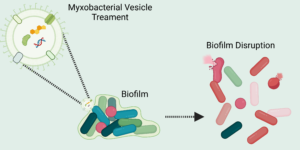
Extracellular vesicles and bacterial vesiclesOur focus is on the characterisation of extracellular vesicles (EVs) as natural conveyers of cellular information. EVs are nanoparticles of 50-200 nm in size that are produced naturally by virtually all eukaryotic and prokaryotic cells. EVs consists of a lipid double layer, carry signal molecules, such as proteins or nucleic acids (e.g. microRNA), and are very efficient cell-cell communicators that migrate from one cell type to another, interact with the target cell by means of their surface and membrane proteins and thus transfer signal molecules in a highly specific manner. We are interested to understand the role of EVs during infection but we also want to use these biogenic carriers to transfer molecules of choice to target tissue. We aim at incorporating these drug-loaded EVs in a pharmaceutical formulation and evaluate its efficiency in complex in vitro and in vivo models. Moreover, we isolate and characterise bacterial EVs and study how these interact with other bacteria, bacterial biofilms or human cells and which physiological role they have. New therapeutic approaches to combat bacterial infections can be derived from these studies.
|
 |